

Around this time of the year, you often hear people exclaim, “Where did the year go?” Yes, we have, in fact, been passengers on the earth for another trip around the sun. A journey that took 8,760 hours (525,600 minutes) while we went about our lives. Noticing the end of the year naturally kicks in something remarkable in our minds: the reflection mode. We often do that with our personal and professional lives and even our businesses.
When we were younger, the end-of-year review was done for us by our teachers. I remember, as a youngster, dreading, with good reason, what trouble my report card would bring me for the holiday season. In the business world, we call it an “EOY (End-of-Year) Reflection”. Whatever we call it, this concept is not a foreign one to most of us.
It goes without saying that dental practices, like any other business, should perform an end-of-year review to identify the ups and downs during the previous 12 months. As a nod to those teachers who had me worried all those years ago, I will call it an “End-of-Year Practice Management Report Card”.
“If you don’t know where you’ve come from, you don’t know where you’re going.” Maya Angelou
As a data analyst at heart, this quote by the poet Maya Angelou has always resonated with me. This is precisely the theory behind conducting reviews using data analytics: analysing historical and current data (where you’ve come from) to provide insights for the future (where you’re going).
Every dental practice is its own unique organism. Depending on multiple factors such as the ownership structure, growth ambitions, business lifecycle stage, location, and patient demographics, the values and targets of the key performance indicators (KPIs) can vary. In other words, not everyone is getting the same report card. Based on what you measure at your practice, how you grade your review can differ from the practice down the road.
Regardless of the success criteria for your practice, let’s explore five subjects (keeping up with our theme of the report card). We will look at each subject through two lenses: historical (what happened during the year) and current (a snapshot of the practice). This year, we’ll also examine how artificial intelligence (AI) is transforming each of these critical metrics.
1. Patients
a. What happened? – Net Patient Gain
Net Patient Gain is often overlooked in favour of the New Patients metric. However, if a practice does not effectively measure its Net Patient Gain, especially in an end-of-year review, there is no indication as to whether the practice is growing its patient base or filling up a leaky bucket at a considerable cost.
To calculate Net Patient Gain, you only need two numbers.
- New Patients– The patients the practice has seen for the first time this year.
- Churned Patients (also called attrition or lapsed patients) – This is the number of patients whose 18-month* anniversary since their last visit fell during this year.
*18 months is commonly used across the dental industry as the “churn point”, although some practices and consultants may pick a different period.
Once you know your two numbers, the Net Patient Gain equation is quite straightforward.
Net Patient Gain = New Patients – Churned Patients
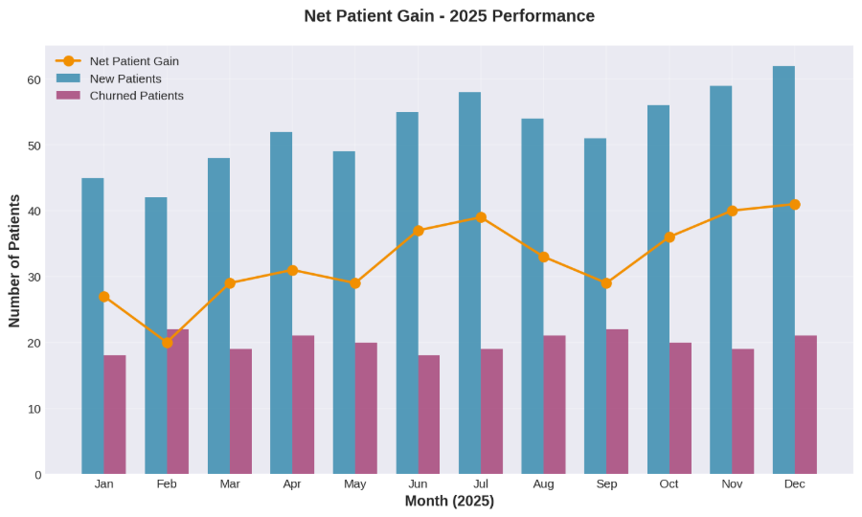
Below is an example of a practice reflecting on “what happened” in terms of Net Patient Gain throughout 2025.
AI-powered patient engagement systems are revolutionising how practices capture new patients. Platforms like DentalFlo AI and HeyGent provide 24/7 virtual receptionist services that answer patient enquiries, book appointments, and provide practice information around the clock. These systems handle multiple simultaneous calls, ensuring practices never miss a new patient opportunity. Studies show that dental practices miss approximately 50-100 new patient calls monthly, leading to roughly $100,000 in annual revenue loss. AI receptionists capture these leads 24/7, with practices reporting that 42% of inbound calls are from new patients who would otherwise be lost to missed calls.
b. Snapshot – Active Patients
The “Active Patients” snapshot can be extremely helpful in determining where your practice sits at the end of the year.
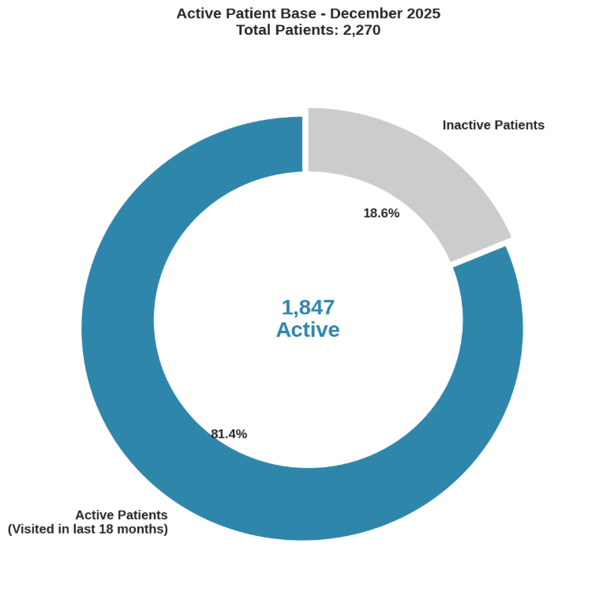
The most common definition of an “Active” patient is “A patient who has visited the practice in the last 18 months”. The number 18 comes from the concept of the traditional three six-monthly recall cycles. It is important to note that, nowadays, dental practices tend to tailor their recall strategies and intervals to align with their overall marketing strategy. Therefore, they may not necessarily adhere to the traditional recall cycle.
Here’s an example of a practice checking its active patients at the end of 2025:
AI systems like Viva AI and Arini can automatically identify active patients who lack future appointments and initiate personalised outreach campaigns. These platforms integrate directly with practice management software to analyse patient data, identify at-risk patients, and trigger automated follow-ups via SMS, email, or voice calls. Practices using AI patient engagement report achieving a 90% call answer rate whilst providing patients with continuous access to scheduling, significantly reducing patient churn.
2. Recalls
a. What happened? – Recall Effectiveness
There are many schools of thought on what should be considered “Recall Effectiveness”. Some practices that book six-monthly recall appointments in advance measure the effectiveness of their recalls by the number of patients who actually attend those pre-booked appointments. Some take an even simpler approach by looking at the number of active patients who returned for a periodic oral exam in the last six months.
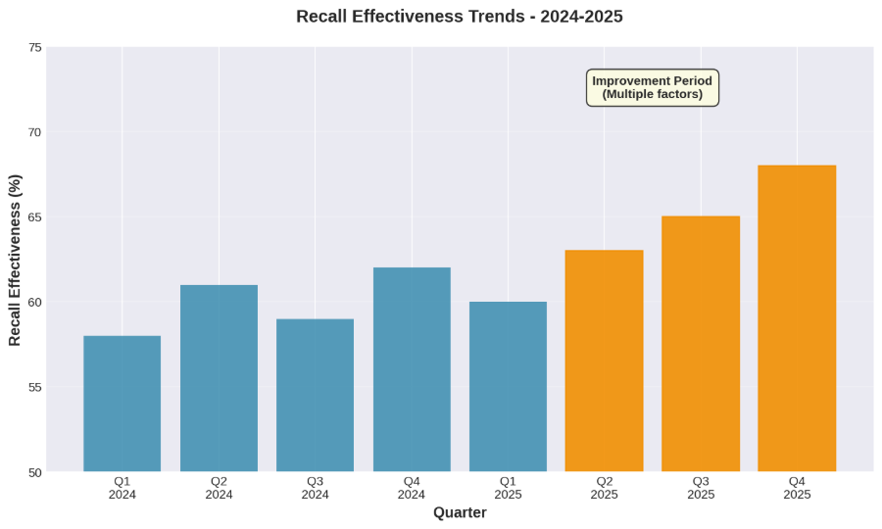
However, the most widely accepted definition of Recall Effectiveness is the following
Recall Effectiveness = Number of patients who booked their recall appointment / Number of patients contacted to book their recall appointments
Regardless of your definition and the formula, measuring Recall Effectiveness will give you an excellent end-of-year indication of how you performed during the year.
AI-powered scheduling and reminder systems have transformed recall management. These systems use natural language processing to engage patients in conversation, reduce no-shows through intelligent reminder timing, and predict optimal contact times based on patient behaviour patterns.
b. Snapshot – Active Patients on Recalls
It does not matter whether you consider a recall date or an actual appointment as a recall, the Active Patients on Recalls snapshot is a powerful indicator of the future success and even the survival of the practice. Measuring this value at the end of the year tells you if you have sufficient revenue opportunities and the foundations in place for positive patient base growth in the coming year.
AI-powered recall automation systems like Newton, TrueLark, and Emitrr have transformed this metric dramatically. These platforms automatically identify patients overdue for recalls and initiate personalised outreach via SMS, email, and voice calls. Automated recall systems have demonstrated 19-31% improvements in patient retention rates, with practices reporting that AI-driven recall campaigns generate 25-35% better response rates than traditional methods. One practice using AI recall automation scheduled 10 cleanings in a single morning, equivalent to five months of product costs. With 89% of patients preferring text message reminders, AI systems ensure no patient falls through the cracks whilst reducing administrative burden by an average of 12 hours per week.
3. Treatment Acceptance
a. What happened? – Treatment Acceptance Rates
One would think Treatment Acceptance is a relatively straightforward metric to measure. It is the treatment plans presented versus accepted. How hard can that be? The reality is that Treatment Acceptance is one of the most challenging metrics to measure.
It comes down to two factors:
i. The definition of Treatment Acceptance– If a patient accepts a course of treatment, some treat the entire treatment plan as “accepted”. In contrast, others take a more granular approach by looking at individual items. The latter cohort considers a treatment “accepted” if the item has been completed or booked.
ii. Immaculate Record Keeping– If you present the patient with multiple options, and they accept one, do you correctly mark the other plans as “inactive”so they are not included in the calculations? If the patient only partially accepts the treatment plan, do you create a new one?
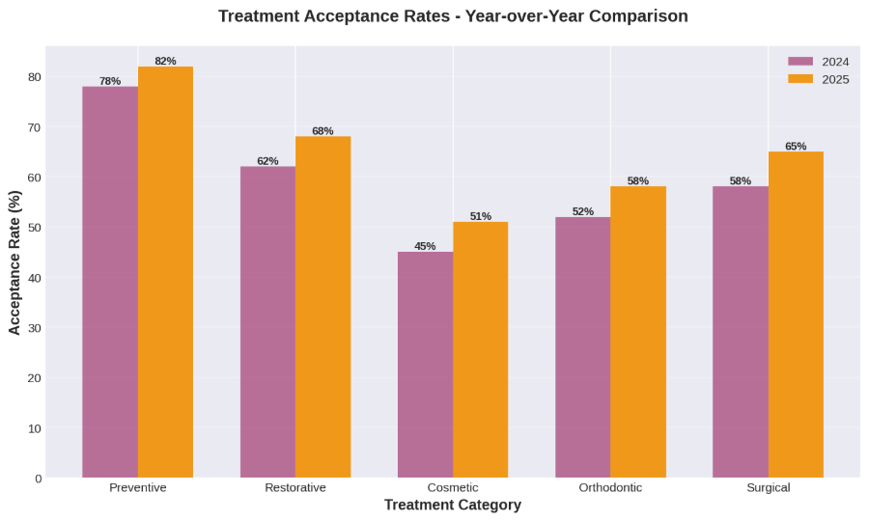
AI has made a remarkable difference in treatment acceptance. According to recent studies, 59% of patients trust their dentist more when AI is utilised in their care. AI-powered diagnostic tools can analyse dental X-rays with accuracy rates of 82-95% (compared to approximately 40% for traditional methods), helping dentists identify issues earlier and present more compelling, evidence-based treatment plans.
The following example shows how treatment acceptance rates improved across categories when comparing 2024 to 2025, particularly in practices that adopted AI diagnostic imaging.
b. Snapshot – Value of incomplete treatments
The “Value of Incomplete Treatments” snapshot is a rather popular one among data-savvy dental practices, especially at the end of the year. It shows what has been left on the table and what can be done to bring in additional revenue from the existing patient base in the coming year.
Typically, you look at the treatments presented to patients in the last 12 months. You can always go back longer and look at the outstanding treatment if you are willing to do the hard work of activating treatment plans that have been dormant for over a year.
The following is a valuable incomplete treatment snapshot of a practice.
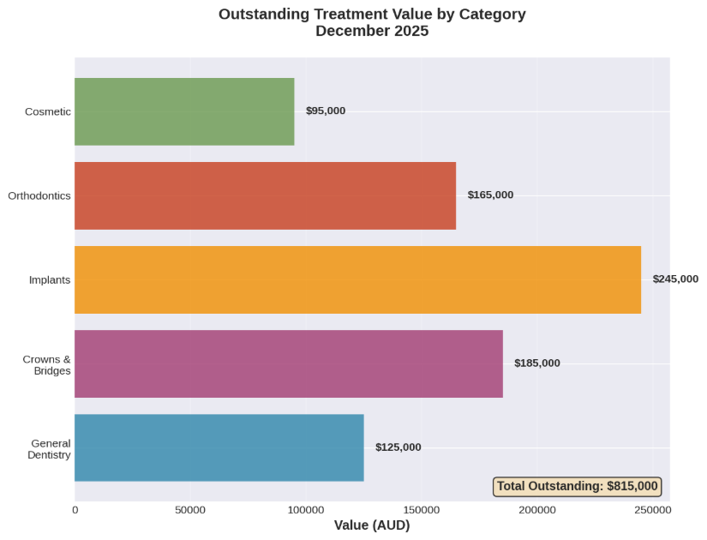
AI diagnostic platforms like VideaAI, Pearl AI, and Overjet are helping practices convert incomplete treatments into booked procedures. These systems analyse patient radiographs with high accuracy, automatically generating annotated visuals that clearly show pathology. This evidence-based approach builds patient confidence and improves treatment acceptance. Practices using AI diagnostic tools report that the technology “gives patients the push they needed to move forward,” with dental organisations noting that AI-powered treatment presentations have become essential to their clinical workflow. The clear visual evidence generated by AI helps re-engage patients with dormant treatment plans, turning outstanding treatment value into scheduled revenue.
4. Appointments
a. What happened? – Appointment Rebook Percentage
The standard definition of a rebooked appointment is “A future appointment booked by a patient on the day of their treatment”. Some practices make minor modifications to this definition and consider an appointment as “rebooked” if it is booked within 48 hours or X number of days. Reviewing how your practice performed during the course of the year will help you identify what you did well and what could be improved.
Using the standard definition above, the formula for rebook percentage is:
Appointment Rebook Percentage = Future appointments booked on the day of treatment / Completed Appointments
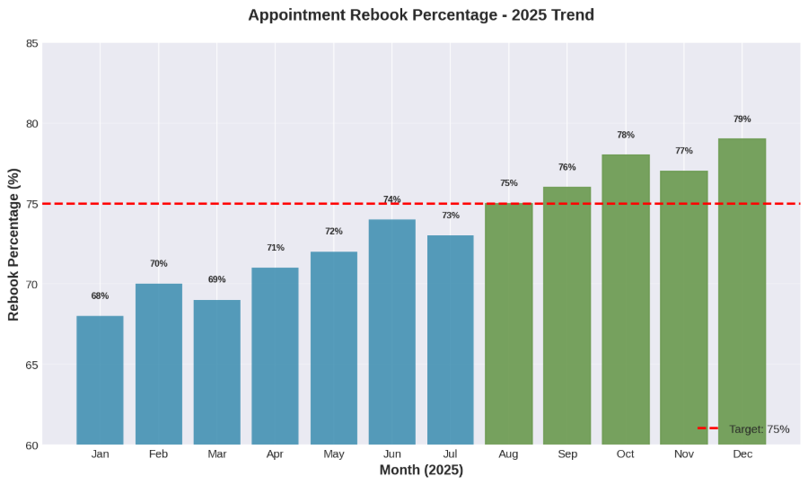
AI scheduling systems like TrueLark, AirClinic.ai, and Simbo AI have revolutionised appointment rebooking through intelligent automation. These platforms use predictive analytics to identify optimal appointment times, send interactive reminders that allow one-click rescheduling, and automatically fill cancellation gaps by contacting waitlisted patients. Practices implementing AI scheduling report 30% reductions in no-shows, 80% decreases in missed calls, and 60% improvements in rebook rates. One practice noted: “Since implementing AI scheduling, our no-show rate has dropped by 60%, and we’re seeing 25% more patients without adding staff.” The technology ensures patients can book appointments 24/7 via text, voice, or web chat, eliminating phone tag and maximising chair utilisation.
b. Snapshot – Active Patients with Future Appointments
The Active Patients with Future Appointments snapshot helps understand the size of the opportunity for generating additional revenue by reviewing the patients without future appointments. This snapshot is often combined with the “Patients with Future Recalls” snapshot to identify the cohort of active patients that may slip through the cracks unless targeted efforts are made to get them back in the dental chair.
AI scheduling platforms like Arini and Viva AI excel at addressing this challenge. These systems can improve schedule utilisation by up to 30% through optimised booking, automated reminders, and intelligent gap filling. AI automatically identifies patients without future appointments and initiates proactive outreach to schedule their next visit. The technology uses dynamic scheduling algorithms that balance provider workloads, minimise downtime, and ensure optimal time slot allocation. Practices report that AI scheduling fills cancellation gaps instantly by automatically contacting waitlisted patients, ensuring no revenue opportunity is lost.
5. Production
a. What happened? – Hourly Net Production
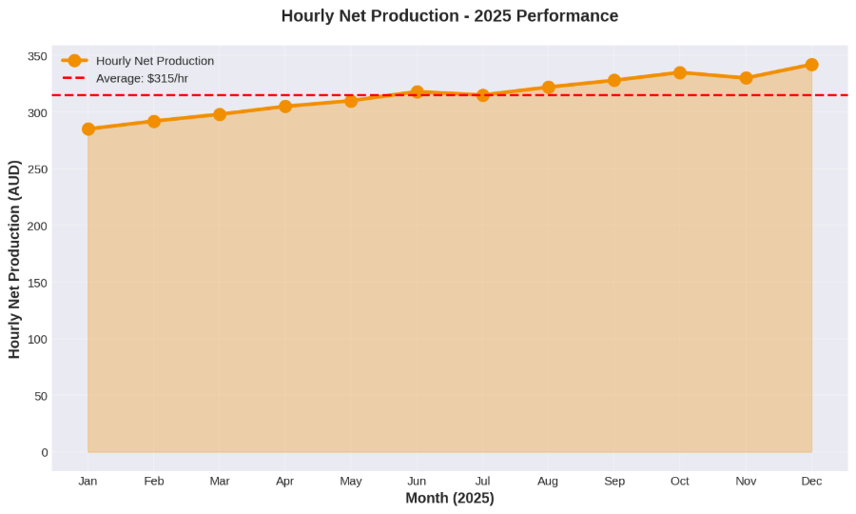
Hourly Net Production is a valuable metric to show the health of the practice over the last 12 months. In addition to providing information about the dollar value of a patient hour, it is also a good indication of the treatment mix offered by the practice, treatment plan values and, in some cases, even the success of treatment acceptance.
The calculation of this metric is:
Hourly Net Production = Net Production Value / Number of Patient Hours
Reviewing the last 12 months will help you understand seasonal trends and patterns that correspond to certain events at the practice (e.g., the highest producer was on annual leave).
AI has helped practices optimise their scheduling to maximise production hours. Machine learning algorithms can predict appointment durations more accurately, reduce gaps in the schedule, and suggest optimal treatment sequencing. Practices using AI scheduling tools have reported operational cost reductions of 20-30% through improved efficiency.
b. Snapshot – Debtor Ratio
Although production metrics are not typically used when creating a “status quo” snapshot of a practice, we will use the historical production values combined with the current debtor amounts to produce the Debtor Ratio. The Debtor Ratio is a valuable metric in determining not only the debtor amount but also if that debtor amount is sitting at a healthy rate.
The Debtor Ratio is typically calculated using the following formula:
Debtor Ratio = Total Debts / Average Net Production for the Last 12 Months
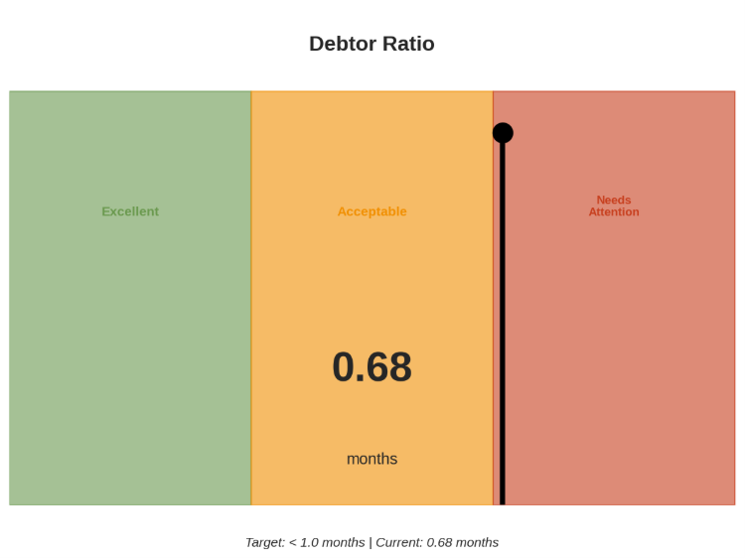
AI is transforming dental revenue cycle management and patient collections, directly impacting debtor ratios. Platforms like Pearly automate payment posting and patient billing processes. Smart billing automation triggers patient payment reminders via SMS with text-to-pay features, making it easier for patients to settle balances promptly.
Practices using AI-powered billing automation report reducing Days Sales Outstanding (DSO), the average number of days required to collect revenue, significantly. AI platforms like Pearly demonstrate average 33% boosts to collection rates whilst reducing administrative overhead by 25-30%. By automating the most labour-intensive aspects of collections and ensuring faster, more accurate payment posting, AI helps practices maintain healthy debtor ratios whilst freeing staff to focus on patient care rather than chasing payments.
The AI Revolution in Dental Practice Management
As we close out 2025 and look towards 2026, it’s impossible to ignore the transformative impact of artificial intelligence on dental practice management. The statistics speak for themselves: approximately 35% of dentists have now implemented AI in their practices, with 77% reporting positive outcomes.
What makes this shift particularly significant is patient acceptance. Data shows that 59% of patients are more likely to trust their dentist when AI is utilised in their care. This isn’t just about technology for technology’s sake. It’s about building confidence, improving accuracy, and delivering better outcomes.
The following chart illustrates the measurable impact AI implementation has had on key practice metrics over a six-month period:
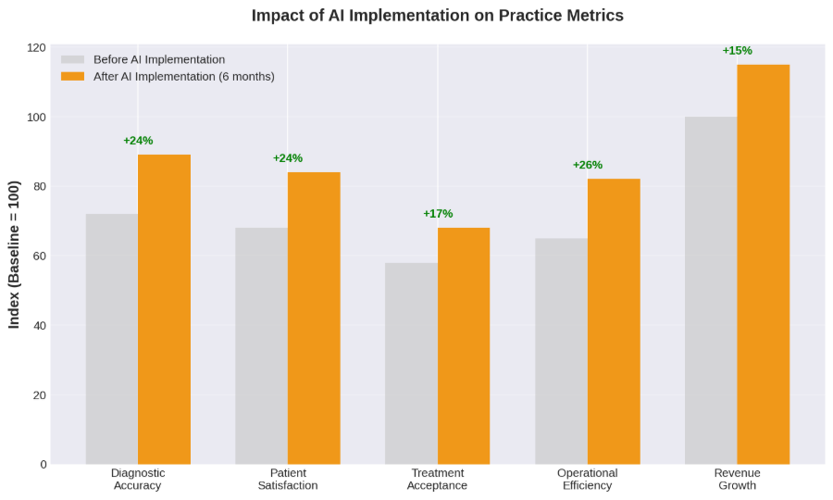
From diagnostic imaging that can detect cavities up to five years earlier than traditional methods, to natural language processing systems that streamline patient communication, AI is no longer a future possibility. It’s a present reality that’s reshaping dental practices across Australia.
Notably, in January 2025, Pearl AI partnered with Centaur Software to integrate AI diagnostic tools into the Mediasuite platform, bringing cutting-edge AI capabilities to dental professionals across Australia and the Middle East.
Conclusion
Keeping on with our report card theme, the five subjects (Patients, Recalls, Treatment Acceptance, Appointments, and Production) reviewed through the two lenses (historical and current) will give you a good idea of how your practice performed in the year gone by, and where it stands on the verge of yet another journey around the sun.
The grades you give yourself on the report card will entirely depend on what you set out to achieve at the beginning of the year. If you did not set goals for this year, do not fret. Give yourself an A for putting the report card together. You now have all the information you need to tackle the new year head-on, armed with insights from both traditional metrics and emerging AI capabilities.
As we’ve explored throughout this article, AI is no longer a future consideration but a present reality transforming every aspect of dental practice management. From AI receptionists capturing new patients 24/7, to automated recall systems improving retention by up to 31%, to diagnostic platforms achieving 82-95% accuracy, and revenue cycle automation reducing collection times by 50%, these tools are delivering measurable results today. The practices that thrive in 2026 will be those that successfully blend time-tested practice management principles with these powerful AI capabilities, using data-driven insights to improve patient care and operational efficiency continuously.
I hope the report card you created in your “reflection mode” gives you cause for celebration, and I wish you a happy holiday season and the best of luck in 2026.
*This article was originally published in 2022 and has been refreshed with 2025 data and insights on artificial intelligence in dental practice management.
References
AI Adoption in Dentistry
Henry Schein Dental Trends Outlook for 2025. Titan Web Agency. “Top Dental Industry Trends for 2025: What Practices Need to Know.”
GoTu Dental. (2025). “AI In Dentistry 2025: How 35% Of Dentists Are Using AI.”
Patient Trust and AI
Forbes. (2024). “AI Would Make More People Trust Their Dentist More, New Survey Shows.”
AI Diagnostic Accuracy
Evidence-Based Dentistry. (2025). “Artificial Intelligence in dentistry: an overview of systematic reviews and meta-analysis.” Nature.
Open and Affordable Dental. “50 Interesting Statistics on How AI is Revolutionizing Dentistry.”
Operational Efficiency and Cost Reductions
Appinventiv. (2024). “AI in Dentistry: Benefits, Applications and Real-World Cases.”
AI Virtual Receptionists and Patient Engagement
DentalFlo AI. (2025). “AI Dental Receptionist & AI Powered Receptionist.” dentalfloai.com
HeyGent. (2025). “AI dental receptionist | #1 AI receptionist for dentists.” heygent.ai
Arini. (2025). “How an AI Receptionist Helps Improve Schedule Utilization in Dental Offices.” arini.ai
AI Scheduling and No-Show Reduction
Dialora AI. (2025). “AI-powered dental appointment scheduling system.” dialora.ai
TrueLark. (2025). “Dental Appointment Scheduling Software.” truelark.com
Viva AI. (2025). “AI in Dental Practice: Reducing No-Shows and Optimizing Schedules.” getviva.ai
AI Patient Recall Automation
DentalAI Assist. (2025). “Dental Recall System Effectiveness: Data-Driven Evidence for Automated Patient Retention.” dentalaiassist.com
Emitrr. (2025). “10 Best Patient Recall Software to Streamline Your Practice.” emitrr.com
AI Diagnostic Imaging and Treatment Acceptance
VideaAI. (2025). “Dental AI Assistant for DSOs & Practices.” videa.ai
Overjet. (2025). “Guide to Dental Revenue Cycle Management with AI.” overjet.com
AI Revenue Cycle Management
Pearly. (2025). “#1 Dental Revenue Cycle Automation Software.” pearly.co
Thoughtful AI. (2025). “Automate the Dental Industry with Bots.” thoughtful.ai
Tech Bullion. (2025). “Dental Revenue Cycle Management with AI for Dentists.” techbullion.com
Pearl AI and Centaur Partnership
Global Market Insights. (2025). “Dental Practice Management Software Market Report 2025-2034.” January 2025 partnership announcement.

About the Author
Sean Perera
Chief Technology Officer
